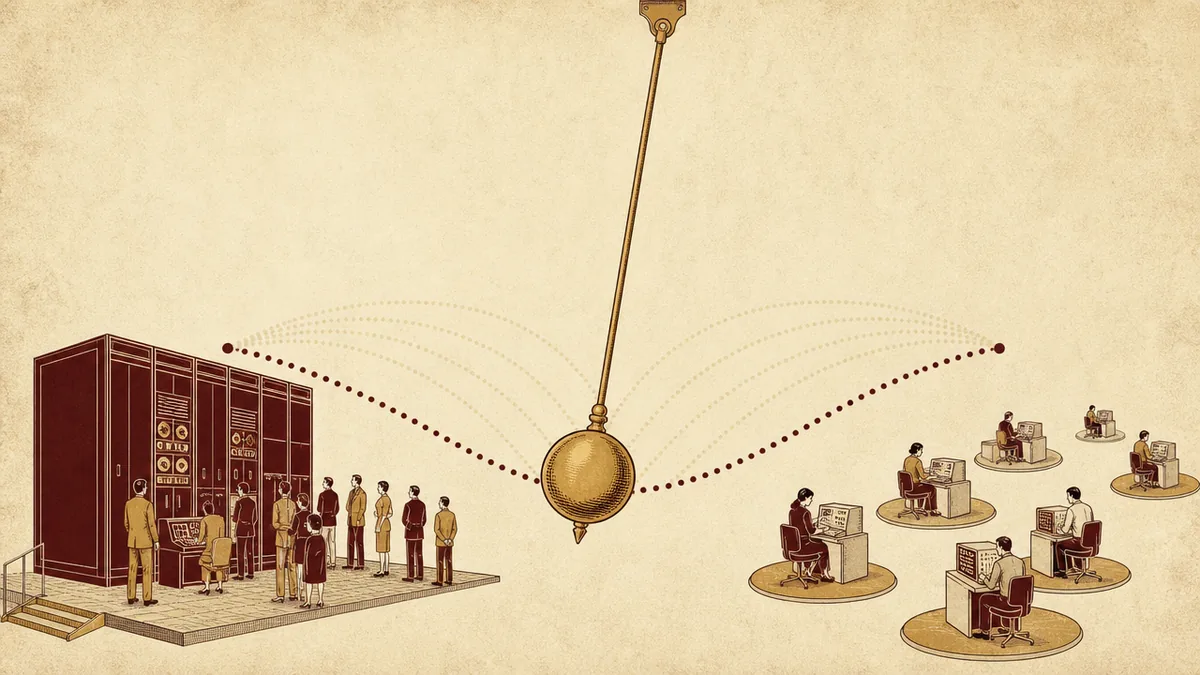
Timesharing did not die because computers got cheaper. It died because of the phone bill.
That detail gets left out of every retelling, and it is the one that matters. The service bureaus of the 1960s sold exactly what a cloud provider sells today: someone else’s expensive hardware, rented by the hour, with the idle time as their problem rather than yours. The industry has since abandoned that model, rebuilt it, abandoned it again, and rebuilt it a second time. Each swing was argued as though it were new. None of them were.
The First Centralization Was Not a Choice
In the mid-1960s a mainframe cost millions, which meant almost nobody bought one. You rented access instead. General Electric launched its GE-265 timesharing service in 1965, pairing a GE-235 processor with a Datanet-30 communications controller so customers in several states could work interactively on a machine they would never see. IBM ran the Service Bureau Corporation and, by 1966, a nationwide network of timesharing centers. Tymshare, founded in 1964 in Cupertino, would later build its own packet-switched network — Tymnet, 1969 — on Varian Data 620 minicomputers, because getting customers to the computer turned out to be as hard a problem as the computer itself.
Contemporary estimates put roughly 800 service bureaus in operation by 1966, together taking in around $650 million and growing about 40% a year. The logic was airtight. A single company’s workload could never keep a million-dollar machine busy. A bureau serving hundreds of companies could. Utilization was the entire business model, and it worked because the alternative did not exist.
What Actually Killed It
Then Digital Equipment Corporation shipped the PDP-11 in 1970 at $10,800 — against $300,000 for the commercially unsuccessful PDP-6 a few years earlier. Minicomputers landed in a price band that a single department could authorize without involving the board. The received explanation stops there: hardware got cheap, so everyone bought their own.
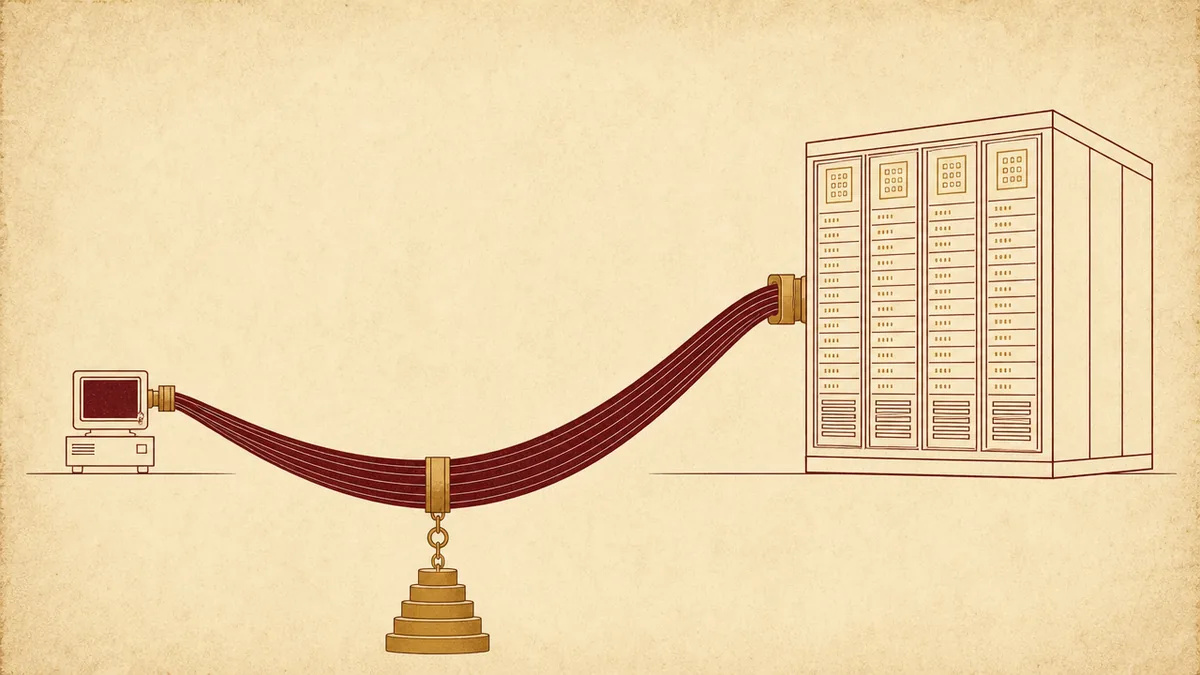
But cheap hardware alone does not beat a bureau, because the bureau’s advantage was never the cost of the machine — it was the cost of the machine sitting idle, which the bureau absorbed across many customers. What broke the model was the cost of getting to it. Interactive timesharing meant a leased line or a long-distance call open for the duration of the session, and those telephone charges were, in the words of one history of the period, prohibitive enough to drive the economics in favor of the minicomputer and undermine the bureaus outright.
Read that again with 2026 eyes. The decisive variable was not compute. It was data transport. Hold that thought — it comes back.
The ASP Boom Ran the Entire Cycle in Three Years
By the late 1990s the pendulum had swung fully the other way: every company ran its own servers, and running them was miserable. The Application Service Provider was the answer, and it is the closest historical parallel to the modern cloud pitch — enterprise software, hosted centrally, rented per user, no infrastructure of your own.
The money arrived first. USinternetworking was founded in January 1998 and went public on 9 April 1999, closing its first day up 174% at $57.50. Corio launched the same year. The forecasts were extraordinary: Gartner measured barely $1 billion of ASP revenue in 1999 and projected $3.5 billion by the end of 2000 and more than $25 billion by 2004. IDC was more conservative and still called for $7.8 billion by 2004.
What happened instead: the market reached about $926 million in 2000. USinternetworking — the segment leader, by IDC’s own ranking — posted a net loss of $175 million on revenue of $109.5 million that year, and filed for Chapter 11 in January 2002, sunk by overexpansion and the debt it had taken on to build data centers. Pandesic was gone by July 2000. FutureLink shut in 2001.
The category did not fail because the idea was wrong. Salesforce had been founded in 1999 on the same premise and is still here. It failed because the ASPs took on the capital cost of centralization — the data centers — while charging per customer, and then ran out of customers before the utilization curve caught up. They were carrying the idle capacity, which is exactly the job, and they could not afford it.
The Cloud, and the Bill for Leaving It
Amazon relaunched the model six years later with the balance sheet to survive it. S3 opened on 13 March 2006 at $0.15 per gigabyte per month; EC2 followed on 24 August at ten cents an hour for a small instance. Metered, self-service, no contract — but structurally the 1966 proposition, restated.
Which brings us to the current swing, and to the best-documented exit on record. 37signals ran an annual cloud bill of $3.2 million in 2022, of which S3 alone accounted for $1.5 million. In 2023 the company spent roughly $700,000 on Dell servers and moved seven applications out in six months; by its own account that year’s savings covered the hardware. By 2024 the bill had fallen to $1.3 million. When its S3 contract expired on 30 June 2025, the company had installed 18 petabytes of Pure Storage across two data centers — about $1.5 million of hardware plus under $1 million for five years of support — and projected storage running costs below $200,000 a year. Five-year savings, initially estimated at $7 million, were revised past $10 million.
These are the company’s own figures, published by a firm that has argued its position loudly, and they should be read that way. David Heinemeier Hansson’s framing — “the industry pulled a fast one convincing everyone it’s the only way” — is advocacy, not analysis.
But look at what made the exit hard. Every additional day on S3 cost $5,000. Amazon granted a free 60-day egress window, waiving roughly $250,000 in transfer fees that would otherwise have been owed simply for taking the data out. The obstacle to leaving was not the price of servers. It was the price of moving bytes across a boundary.
Telephone tariffs in 1975. Egress charges in 2025. Twice now, the thing that decided which way the pendulum swung was the cost of data in transit — and both times the industry narrated it as a story about the cost of hardware.

What the Pendulum Actually Tracks
Strip out the vocabulary of each era and the same trade sits underneath every swing: whoever absorbs the idle capacity wins, until the cost of reaching them exceeds what that absorption is worth.
Centralization wins when a given customer’s utilization is low and unpredictable — a 1966 manufacturer running payroll twice a month, a 2012 startup with no idea whether it will need four servers or four hundred. Decentralization wins when the load becomes steady and known, because at that point the customer is paying a premium for elasticity it no longer uses. 37signals is the clean case: a mature product with predictable, well-understood traffic. That is precisely the profile where renting stops paying, and it is the same arithmetic we traced through local versus cloud AI, where the break-even turns on sustained GPU utilization rather than token volume.
Which is why the current numbers deserve care. Barclays’ Q4 2024 CIO survey found 86% of respondents planning to move some workloads off public cloud — the highest figure it had ever recorded — and IDC puts around 80% of enterprises expecting to repatriate some compute or storage within twelve months. Those numbers get quoted as an exodus. They are not. Only about 8% are moving entire workloads off. The rest are selectively relocating the predictable parts and leaving the spiky parts where elasticity is still worth paying for.
That is the detail every previous swing got wrong at the time. The pendulum has never actually completed its arc. Service bureaus did not vanish in 1975 — payroll processors like ADP kept running the workloads that genuinely suited a shared machine, and are running them still. The ASP collapse did not end hosted software; it cleared the field for the companies with the balance sheet to carry the capital cost properly. The managed services market is forecast to grow from roughly $460 billion in 2026 to about $705 billion by 2031 — hardly the trajectory of a model being abandoned.
What changes each cycle is the boundary: which specific workloads sit on which side of it, and that is a question about your own utilization curve, not about the industry’s direction. We wrote recently about where that line falls for IT operations specifically, and the answer there is the same shape — thresholds, not doctrine.
So the useful question is not whether to be in the cloud. It is narrower and more answerable: which of your workloads have a known, steady shape, what would it cost to move them, and who is currently being paid to absorb idle capacity you no longer have? Answer that honestly and you will land wherever the arithmetic puts you — which, on the historical record, is somewhere in the middle, for about a decade, until the price of moving data changes again.