Talantly.ai

Research project · completed in 2026Talantly.ai is no longer available as a product. Links to talantly.ai now lead to this page.
10development stages
5AI report types
~40 sanalysis per candidate
6+report languages

About

Logo medium — Talantly.aiThe new AI era demands that companies adapt to industry changes. HiTech recognizes and responds to this demand, starting with the recruitment sector. Talantly.ai was our research project on how to apply AI to recruiting.

Talantly.ai’s primary objective was to create an effective AI-driven recruitment process by using a language model that provides in-depth analyses of candidates’ documents throughout the hiring process.

Software

Talantly.ai supported the entire hiring process. It was made to help recruiters make thoughtful decisions and provided all the necessary analyses in the span of minutes. Recruiters could use Talantly.ai throughout all stages of the hiring process: job offer creation, candidate screening, interviewing, and decision-making.
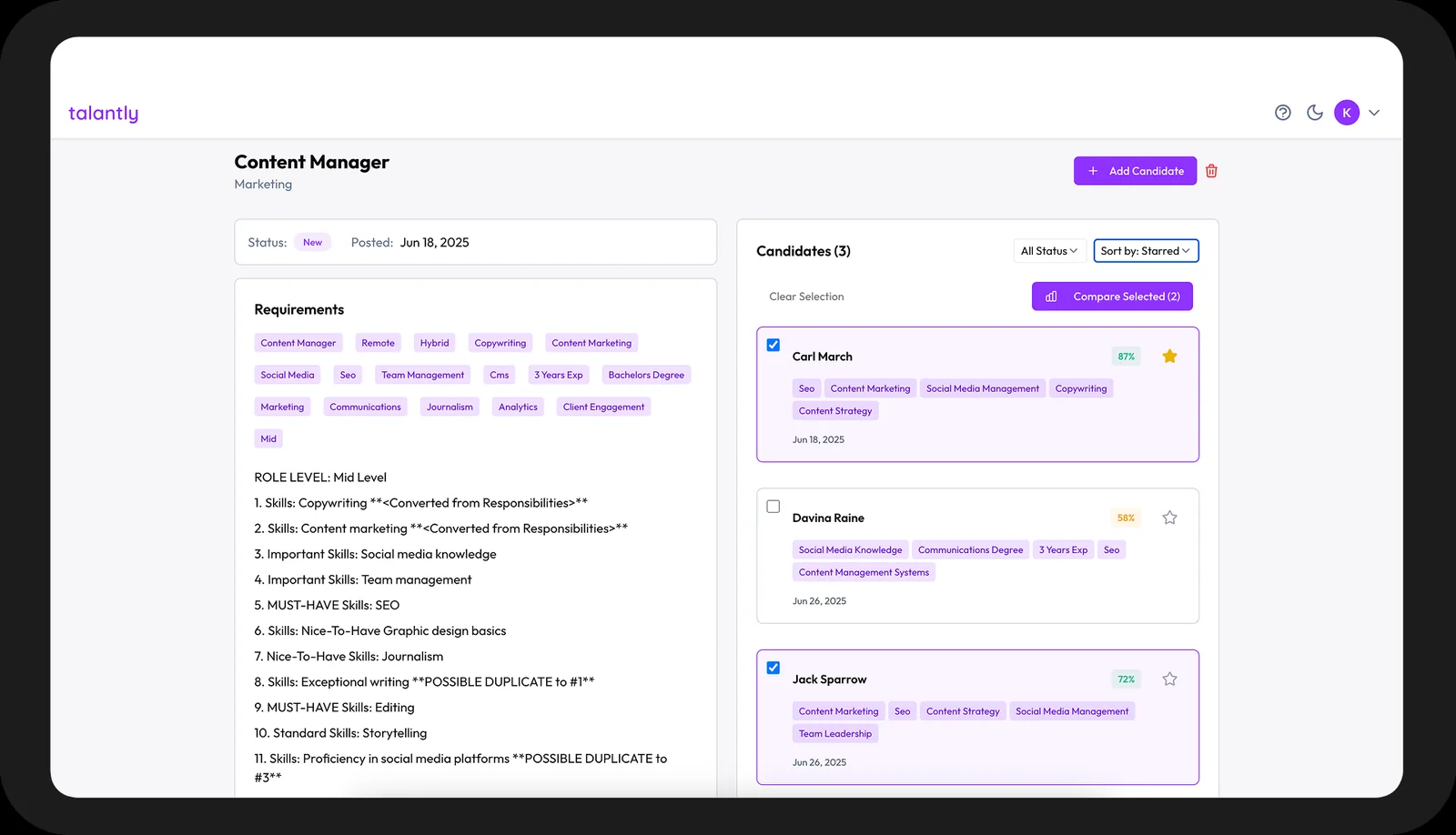
Talantly.ai vacancy screen with AI-extracted requirements and a ranked candidate listJob offer creation stage: Talantly.ai analyzed documents with job descriptions, helping to cut through the noise and create a set list of skills needed for the role, to later use them for candidate analyses as hiring criteria. 
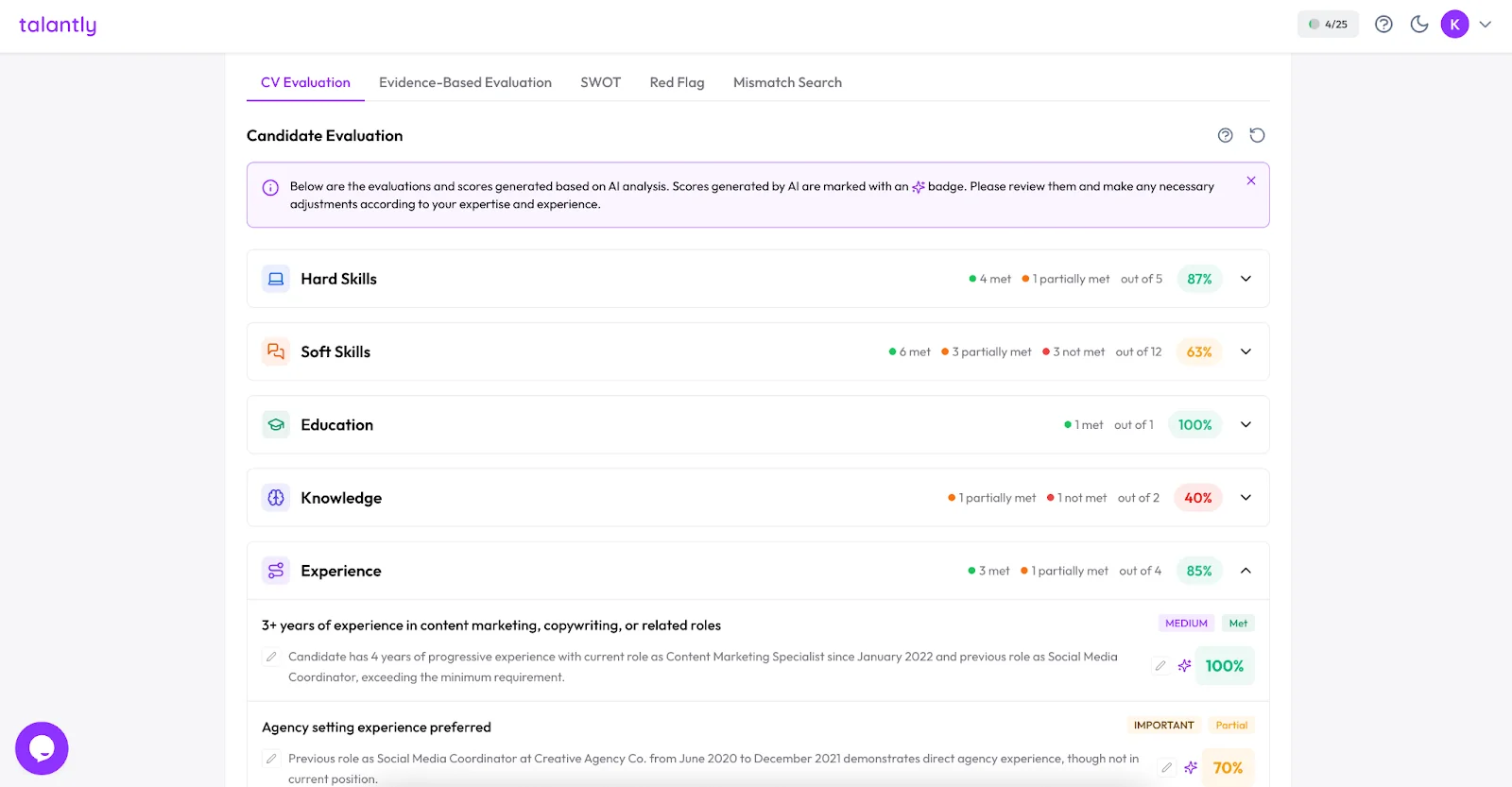
Talantly.ai candidate evaluation with scores for hard skills, soft skills, education, knowledge and experienceCandidate screening: The language model analyzed CVs, motivational letters, interview scripts, and other candidate data. The system created a candidate score linking each score to specific, verifiable excerpts, offering recruiters an objective basis for comparing applicant qualifications and proceeding with the later stages of the hiring process. 
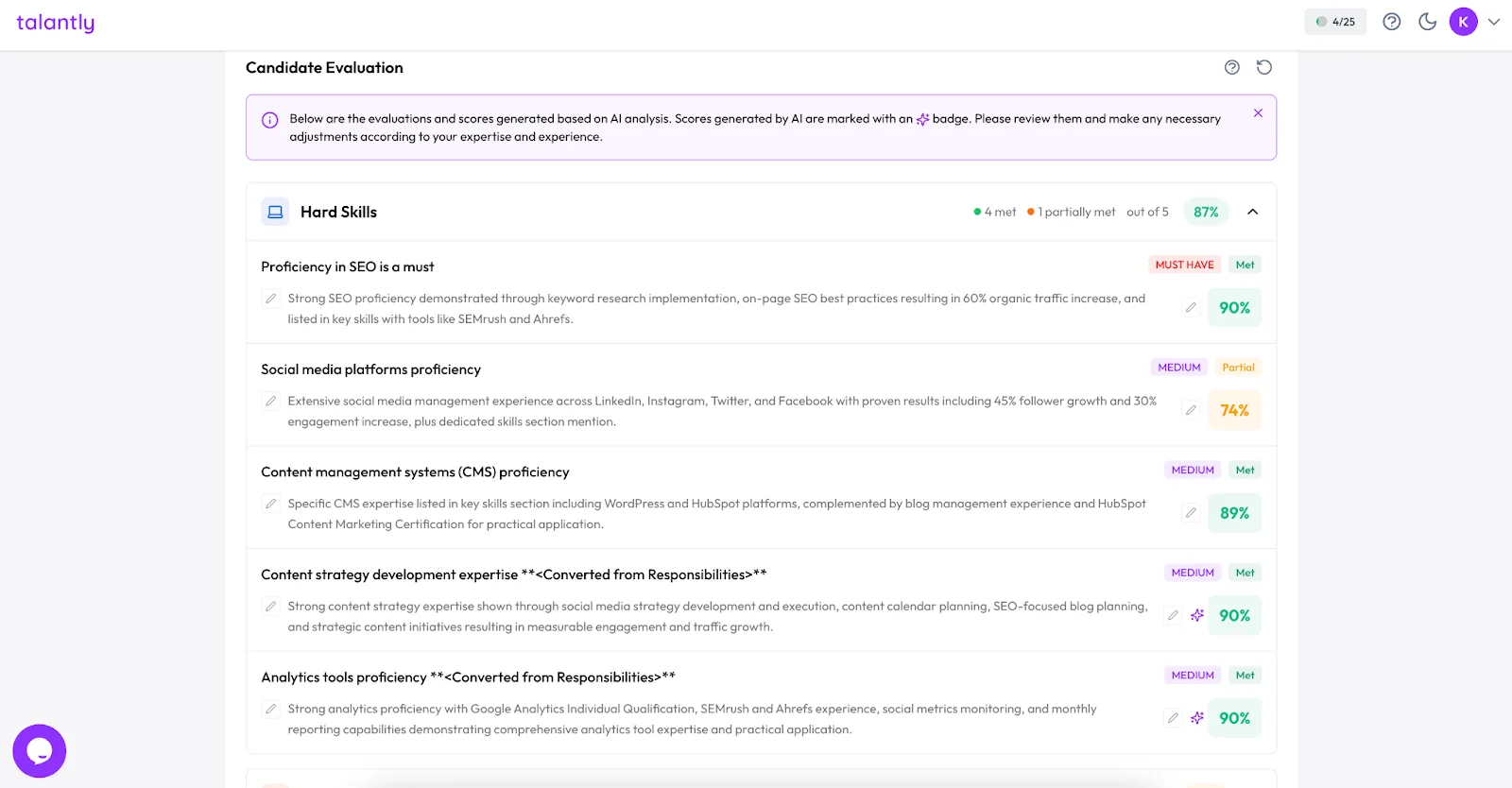
Talantly.ai skills evaluation where each score is explained with evidence from the CVInterviewing stage: Talantly.ai provided recruiters with pre-analyzed insights and a suite of AI recruiting tools. The platform suggested targeted interview questions based on the gaps in the CV to discover more about the candidate and engage with them on a deeper level. Later, recruiters could upload the interview script to get a more in-depth candidate assessment with sources referring back to all the attached documents.

Decision-making stage: Methodologies such as SWOT analysis, STAR method, ambitions & motives assessments, and red flag analyses were used. These capabilities ensured that every hire was supported by clear, evidence-based data for a confident and informed selection process.
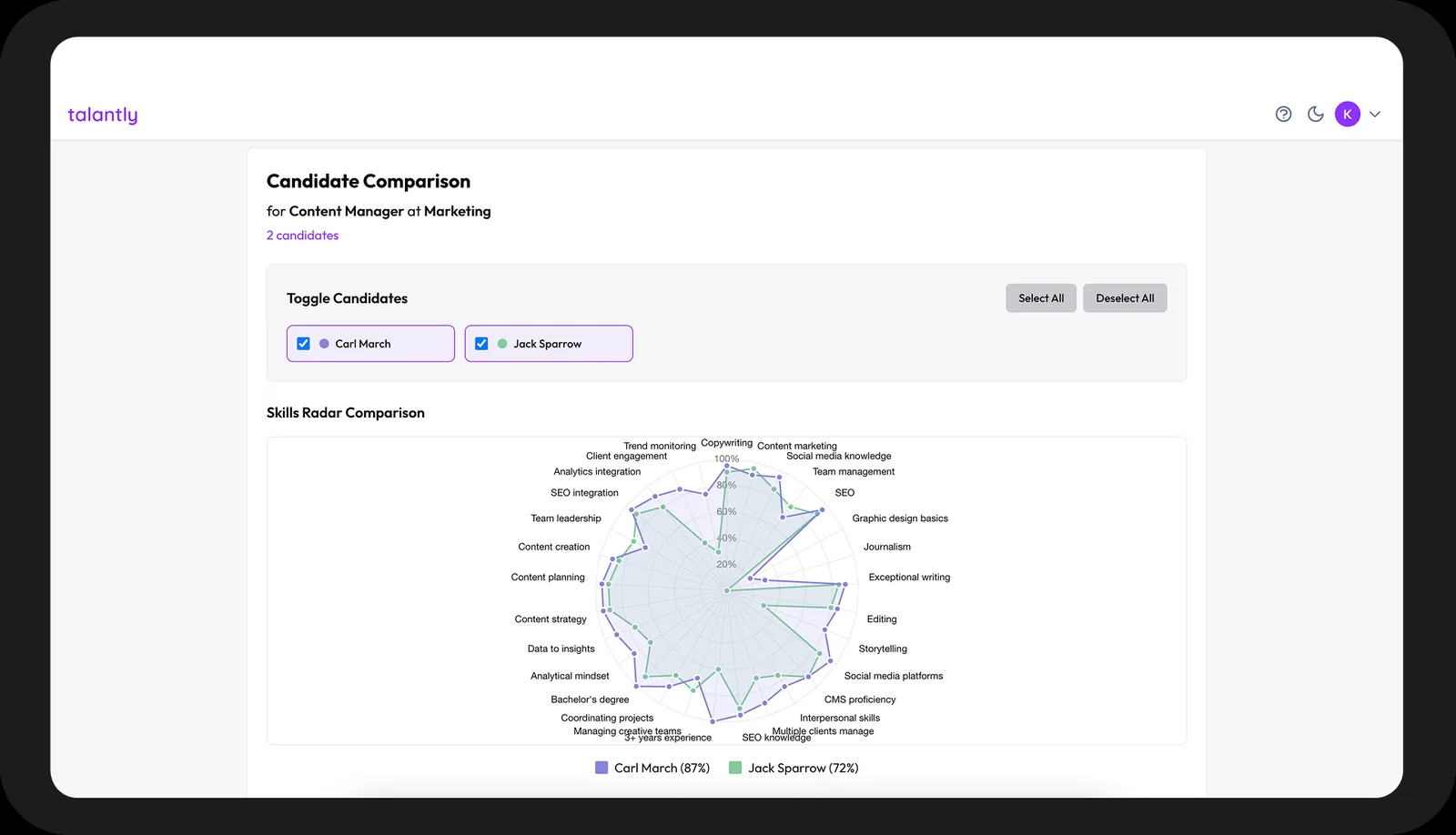

Talantly.ai candidate comparison with a skills radar chart for two candidates

Development Track

  1. 1
    Research

    Research and methodology

    We started with experiments rather than code. The team built test sets of real and synthetic candidate documents (CVs, job descriptions, interview transcripts) and used them to design the core method: score each requirement from 0 to 100 and back every score with a direct quote from the source document.

  2. 2
    Product

    MVP

    The first release covered the whole basic cycle: create a vacancy, upload candidates and get a single AI evaluation report.

  3. 3
    Product

    Iterating on real feedback

    Demos and early testing filled the backlog quickly. The next release reworked the user flow and error handling. It also added search, candidate and vacancy counters, flagged-candidate filters, pasting documents as text, report export, full-screen reports and pagination.

  4. 4
    AI analytics

    Advanced analytics

    Talantly moved from scoring to analysis. We added PDF import and export and three new reports: SWOT Analysis, Risk Assessment (red flags across 11+ categories) and Mismatch Detection, which cross-checks CV claims against interviews and references. Reports could also be refreshed as new documents arrived.

  5. 5
    Product

    New interface and candidate comparison

    The biggest release was a complete redesign of the interface. It added vacancy and candidate tags, smarter vacancy filters and side-by-side comparison of up to five candidates with radar charts.

  6. 6
    Product

    Product polish

    We refined the product for everyday use: a masonry dashboard, a mobile view, draft vacancies, LinkedIn integration, updated scoring zones and plan limits connected to subscription billing.

  7. 7
    AI analytics

    Interactive evaluation

    Static tables became live candidate evaluation cards. The AI pre-fills the assessment, recruiters adjust scores with live recalculation, and the profile keeps updating through the interview. The system also generated interview questions aimed at gaps in the CV, and produced reports in 6+ languages.

  8. 8
    AI engineering

    AI agent and multi-provider architecture

    The analysis pipeline became an AI agent. It processed PDF, DOC, DOCX and plain text, structured qualifications across six dimensions and delivered a full analysis in about 40 seconds per candidate. Under the hood, the product worked with several AI providers and could switch between them without changes to the product.

  9. 9
    AI engineering

    Local AI and own infrastructure

    The final stage took AI off third-party clouds. We ran models on our own infrastructure, trained them and deployed Talantly fully on-premise, from a single Mac Mini M4 for a small team to enterprise server clusters. In this setup candidate data never leaves the client's network, there are no per-token costs, and the system can run in closed, air-gapped environments.

  10. 10
    Outcome

    Research complete

    With the research goals met, we closed Talantly.ai as a product. Its methods, testing practices and AI infrastructure now support other HiTech projects.

Project Outcome

Talantly.ai was a research and development project first. Large commercial success was never the goal. We used a real product to test and refine new approaches to building AI systems, and recruitment made a strict test case: every conclusion about a candidate has to be backed by evidence.

With the research phase complete, we closed Talantly.ai as a product in 2026. Its methods and infrastructure now support other HiTech projects. This is what the project gave the team:

LLM product development

Development practices for LLM-based products, from prompt engineering to architecture that can survive a model change.

Testing non-deterministic AI

Testing methods for AI output that can differ from run to run, built on test sets of real and synthetic documents.

Multiple AI providers

Hands-on work with several AI providers, and a product that can switch between them without a rebuild.

Own AI infrastructure

AI infrastructure built and run in-house instead of relying only on third-party APIs.

Local models in closed environments

Model training and on-premise deployment where data never leaves the client's perimeter, including air-gapped setups.

Evidence-first AI

An approach where every AI conclusion is backed by a quote from the source document, so people can check it.

Thank you to everyone who tested Talantly.ai and shared their feedback.